the owl, the lion, and the dragon
How do you remember a city?
I spent the first half of 2018 in Budapest with the goal of exploring the complex cultures and histories of Central and Eastern Europe. With each new city I went to, I spent hours wandering the streets, photographing architectural details unique to that place. I collected thousands of images of whatever caught my eye, from cathedrals to graffiti, lamp posts to coffee cups. In each city, I started to notice patterns. In Zagreb, the owl appeared on top of state buildings and stenciled onto a street corner. In Ljubljana, the dragons on the Zmajski Bridge watch like sentinels over the city, and their delicate but strong bodies echo in the waves of the river and whimsy of the architecture. In Budapest, gateways and doorways are intricately designed, no two of them alike—and often, they are accompanied by watchful stone lions. Many of the cities in this exhibit seem mysterious to us in the United States. While tourism has exploded in Prague and is steadily on the rise in Budapest, cities like Pécs and Ljubljana remain unknown. As someone with Eastern European heritage, I wanted to learn more about these places and their vibrant cultures, divergent from those in Western Europe. Each collage is a conglomeration of the artwork and cultural idiosyncrasies I observed in each place, serving as my personal mementos of these cities. Spanning as west as Berlin and as east as Istanbul, they only scratch the surface of the lives and stories in each place.
An ever changing city, Berlin is a patchwork of its past, present, and future. The monument to the genocide of the Roma and Sinti peoples is frozen over with ice, reflecting the sky above and the peaks of the Reichstag Building behind it. Monuments like these, atoning for a dark past, stand silently besides brilliant designs in the graffiti on the walls, while pink and green pipes flush out the marsh waters that flow beneath the street.
Monuments from Hungary’s disputed past stand next to a range of political posters, some highlighting the probable future of authoritarianism, others hoping for a change. With last year’s re-election of a government controlled by the Fidesz party, led by Viktor Orbán, Hungary was added to the growing list of countries with far-right political leaders. It was only by talking with distant cousins of mine that I learned how the presidential election system is rigged against any opponents. The reality of the false election starts to show in the thousands of Magyar Kétfarkú Kutya Párt (or Two Tailed Dog Party) posters, a satirical political party that highlights the futile Hungarian political system through protest. The stone lions of the bridges, front yards, and palace courtyards, watch as the city, rebuilt so many times, transforms once again.
A fresh blanket of snow hugs the streets of Sofia, contrasting against the flat, gray walls, and the vibrant paintings that cover them. The cityscape is studded with jewel-like Bulgarian Orthodox Churches, as well as mosques and synagogues. Underground, the streets open up into thousand-year-old crypts.
This is the only city on the wall from a previous year. I took these pictures when I went to Istanbul in 2009. These pictures depict moments from an Istanbul before the social and political turmoil that define/mark the last ten years—a wedding, a hug, and the purrs of cats that the whole city looks after together.
Nestled in between Croatia, Italy, Austria, and Hungary, Slovenia won independence swiftly from Yugoslavia, and has since enjoyed relative peace and prosperity compared to the other Baltic nations. Its capital, Ljubljana, rests upon a river guarded by the dragons of the Zmajski Bridge. Once a year, the “Lighting Guerilla” Light Art Festival, invites artists to illuminate the bridges, alleyways, and old fortresses with fantastical projections and installations of technicolor light.
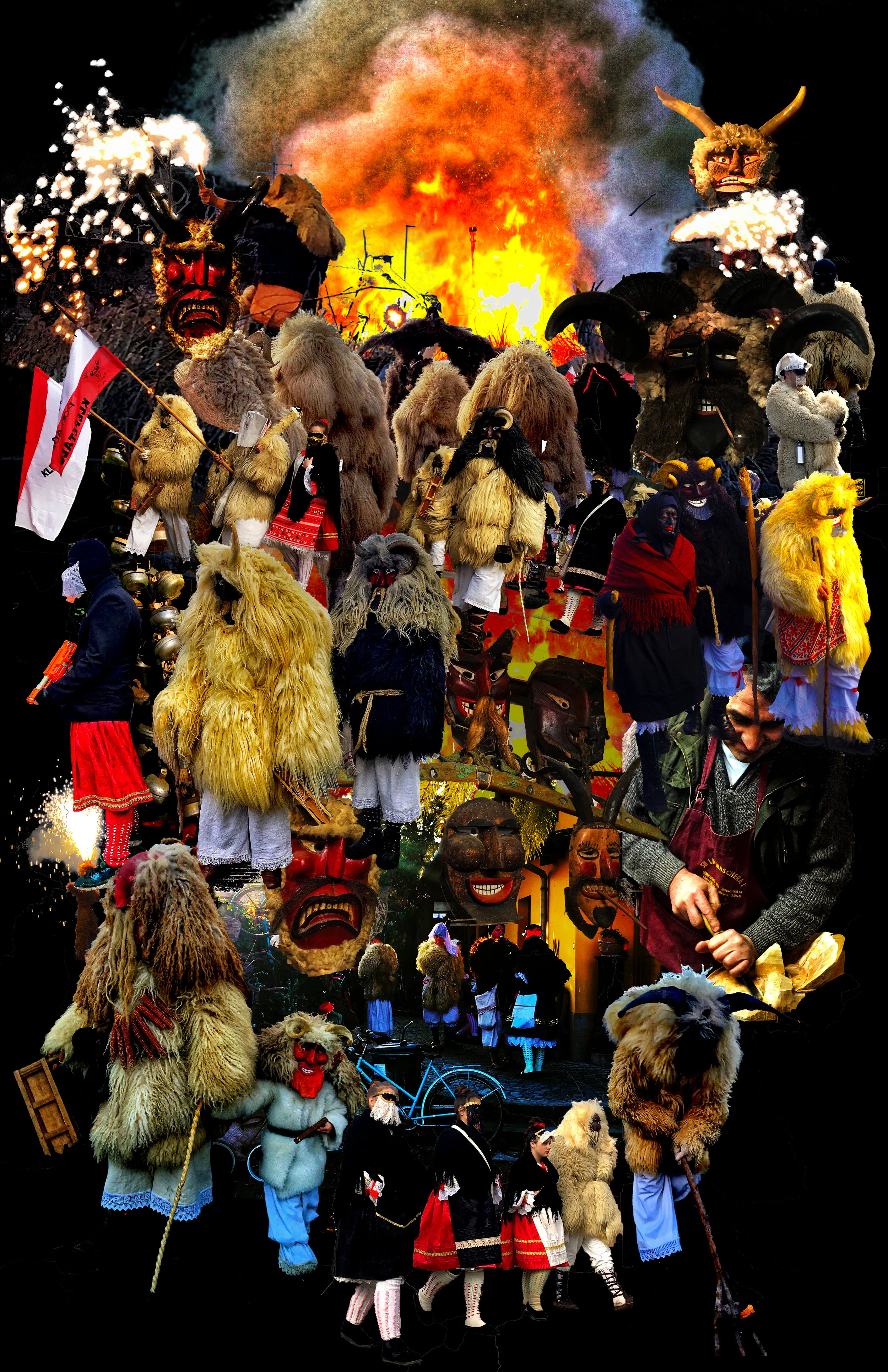
Originally a Serbian tradition, the Busójárás only happens in the city of Mohács, Hungary. On the day before Ash Wednesday, the men of the town dress up as huge,Yeti-like busó, each with an individual hand-carved mask. They parade and run around the town, swinging noisemakers, sometimes accompanied by women dressed as witches. Throughout the festival, the busó also make advances on those women who haven’t dressed up. The history of this tradition is complex, tangled between pagan traditions, Christianity, and warfare between the Ottomans and the Magyars.
The town of Pécs is home to the celebrated Zsolnay Porcelain Manufactory, which has produced famously beautiful porcelain for over a century. Pécs is a town of craft beyond porcelain, including painters, leatherworkers, and even graffiti artists. Underneath the city, a system of tunnels houses thousands of barrels filled with Pécsi cirfandli, a traditional sparkling white wine. Geometric fractals and spirals emerge from the op-art paintings of Victor Vasarely, (who was originally from Pécs), to the twisted snake that forms a porcelain vase at the Zsolnay Museum.
The legacy of Cubism is built into the details of the architecture in Prague. Much of Cubism was inspired from scientific inquiry into the growth of crystals. Crystal is an important part of the visual culture in Prague. Masters of crystalwork and chandelier design have a strong tradition in the city. Next to the diamond-cut cement, monuments to Franz Kafka add a layer of surrealism to the city streets.
I’m the first of my immediate family to go to Romania, where my grandparents are from. They became refugees when World War II was coming to a close, and Soviet troops began taking over the nation. Cluj Napoca is a quiet and strange city, surrounded by the tall mountains and the deep forest of the Apuseni National Park. While the region has been traded back and forth between empires, and continues to undergo poverty and governmental corruption, these mountains are a constant, and remain a distinct part of Transylvanian identity and culture.
The spires of churches and the stone walls of fortresses fill a valley in between looming mountains. On Easter Day, the sounds of church bells fill the streets, while crystal-studded bunny rabbits stare out of shop gleaming shop windows.
A couple days before Easter, the Easter Market is in full bloom outside the Schönbrunn Palace. From the roof of Saint Stephen’s Cathedral to the hand-painted easter eggs, zigzags are everywhere in Viennese ornamental design. Traditional ornament and architecture blend with the whimsical legacy of the turn of the century Vienna Secession Movement. In the Café Central, Empress Elisabeth of Austria, still called informally “Princess Sissi,” gazes over the diners from a golden frame.
With the birth of the Croatian Naïve art movement, Zagreb became the beating heart of an outsider-art community. Contemporary art is infused with traditional folk designs, spreading from the roof of the church to the walls of underground garages. An abandoned building houses the memory of Trash Will Smash, a secret 2016 graffiti exhibit of the Ledana Collective, with glow-in-the-dark paintings and a beanstalk planted in a brick, reaching all the way up through a hole in the roof. Owls decorate dozens of buildings in Zagreb, some spray painted on the walls, and others made of stone, perched on top of buildings, watching the world below.